Dysfunctional hips are an epidemic in our western society. I see it everyday. Yesterday, was a great example. I was asked by a runner "how do I use my glutes? My physical therapist told me I have weak glutes." Her condition was easy to identify even before testing her glutes. She did not have much gluteal tone, but as a long-time runner I can see she had very well developed hamstrings. Additionally, she has pulled her hamstrings many times in the past with distance running. She was very aware of her problem and asked if she should do more squats and lunges to help her develop her glutes.
She has developed synergistic dominance of the hamstring muscles over the gluteus maximus as a hip extensor. And she does a lot of hip extending with running. Synergistic dominance is when one muscle or group takes over as the dominant muscle at a joint. This leads to inefficient use of the hamstrings, poor hip joint stability, and over-use of the hamstrings (which is probably why she experienced strained hamstrings). With testing, I found almost no contribution of the glutes during her hip extension; the hamstrings were doing all the work. Squats and lunges were not a good idea, at this time. She may be able to do them, but would simply be compensating with other muscles, not really fixing the problem.
So how do we get the glutes working and contributing like they should during squatting, lunging, or running? Learning how to use the glutes is the first step. Then, they can be progressively strengthened. Ultimately, they will be integrated into the running pattern with appropriate, progressive drills. We used the barbell hip bridge on a roller to get the glutes going. Lying face up, with the upper back on the roller allows you to focus on the glutes and get helpful feedback. In the video below, a (different) client performs the barbell hip bridge on a roller. In order to perform the exercise appropriately, you need a good, thick pad for the pelvis, and a hard roller (which allow you to pivot your upper body upon). The hips are extended by focusing on squeezing the glutes. The set is stopped if there is any arching of the lower back (synergistic dominance of the lower back muscles over the glutes), or if the hamstrings feel like they are overworking (such as burning or cramping). Also, the client in instructed to "push through the heels", and "spread the knees" as she extends the hips. At the top range of motion, encourage the client to try to get even higher and "push the hips to the ceiling." The last part of the range of motion is crucial, as this is where the glutes contribute the most. The contribution of the glutes should be tested by having the client feel their glutes with their fingers for a strong contraction. This touching gives them feedback on each repetition. It is common for a client to find it difficult, at first, just to get a full lock-out with body weight only. You are changing motor recruitment patterns after all. Over time, with correct technique, it should be easier and easier for the client to powerfully lock-out the hips. The hips can then be progressively overloaded with barbell weight. Below, a client performs the barbell hip bridges with 75 pounds. Notice the smooth, powerful, full, lock-out at the top of the repetition. Once a client is able to lift an appreciable amount of weight (>50% of body weight) and gets the feel of using their glutes, progression to deadlifts and split squats would be appropriate. Ultimately, I would add skipping and bounding drills to help this runner get more glute contribution during running.


Showing posts with label Low-Back Pain. Show all posts
Showing posts with label Low-Back Pain. Show all posts
Tuesday, August 31, 2010


Thursday, August 26, 2010
A Six-Pack of Tips for Preventing Low-Back Pain
 Low-back pain continues to be a highly-prevalent health issue for, well, almost everyone (estimated to be upwards of 80% of the population). Luckily, though, it is more episodic, than chronic, but still very debilitating. Most low-back pain is NOT due to a single, traumatic event, but an accumulation of muscular-skeletal "insults." These 'insults" may appear benign: sitting, driving, sitting, computer work, sitting, watching tv, sitting, eating, sitting, but lead to serious problems. Most of these activities, or lack of activity, negatively affect: muscular tone, fascia fluidity (connective tissue between muscles and bone), muscular activation, flexibility ( too much flexibility is bad), vertebrae alignment, disc integrity, and pressure on the spinal nerves. The result is severe, debilitating low-back pain that seems to be a result of a simple activity, such as putting on your shoes.
A thorough assessment by a physical therapist or a knowledgeable trainer can go a long way to help you prevent a debilitating episode(s) of low-back pain. An appropriate mobility, motor learning, and strengthening program can be very effective. However, many common exercises done at the gym can exacerbate low-back pain (such as crunches and sit-ups). Bottom line, invest your time and money in someone who knows how to assess a client for low-back issues (they can help you figure out the mechanism/possible cause with an interview and a physical assessment), and can appropriately design a program that addresses your deficits in mobility, motor control, and muscular strength. In the meantime, here are six things, that are generally safe for everyone (still use common sense; it anything causes more pain don't do it and see a medical professional), that you can do everyday to minimize your risk or low-back pain. 

- Do not bend or twist spine, especially when you are carrying anything. Bending and twisting the spine is the exact mechanism spine biomechanists use to induce herniated discs in the lab. The extreme bending and twisting damages the disc, which won't hold up long. Instead, move through your ankle, hip and shoulder joints as much as possible, just like a good squat

- Work on hip, shoulder, and upper (thoracic) spine mobility everyday. One of the biggest reasons why people bend through their spines so much is that they are so inflexible in their hips. The hip joint moves in many motions, work on increasing the range of all those motions every, single day.
- Learn how to maintain a neutral spine and 'tune' torso muscle stability for the specific demands on the spine. Keeping the spine 'neutral,' or in its natural "S" curve, protects the discs, nerve roots, and transverse processes of the vertebrae. The torso muscles act as guy wires that maintain the structural integrity of the spine. Some movements require a mild contraction to maintain the neutral spine, while others require more. Learn to tune how much abdominal bracing you need for a given movement and use this while lifting.
- Don't sit for more than 15 minutes. Get up and walk around frequently. Change sitting postures every five minutes. Sitting is extremely stressful on the discs of the spine, as compression forces on the front of the disc increase exponentially, effectively pushing the disc backwards and weakening the disc to where it is very easy to rupture.
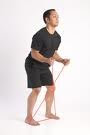

- Move sideways regularly. The muscles on the side of the hip are often stiff and weak. Moving sideways, such as side stepping, or in a similarly challenging way, marching with a pause, help strengthen and loosen up these muscles on the side of the hip.
- Use a split stance or single-leg stance exercise as much as possible to lift things from the the ground. This may sound foreign to you, but these postures are used somewhat in everyday life. Use them more. A split stance exercise like the lunge, makes it easy to keep the back neutral and to use the hips more. A single-leg stance is often used by golfers to pick up their ball out of the hole, as it makes picking up lighter objects off the the ground easier and you can keep a neutral spine.

Subscribe to:
Posts (Atom)